What is a CRM? An example
A CRM is a database built around people instead of invoices. Every inquiry becomes a record, and every record moves through stages until it is won or lost. One lead in a carpet cleaning company's CRM might look like this:
| Name | A homeowner in Sherman Oaks |
|---|---|
| Source | Google Maps listing, then a call tap on the website |
| Asked for | Sectional sofa and two rugs |
| Stage | Quoted, waiting for a date |
| Owner | Front desk |
| Next step | Follow up Thursday |
| History | Call 10:14, quote sent 10:40, text reply 11:05 |
The details
Count those records by source and stage and you have the answer to "which marketing brings jobs." That is the bridge to lead tracking and attribution.
Do I really need a CRM?
You need a CRM when two or more of these are true:
- Leads arrive in more than one place: phone, web form, text, Instagram, a booking system.
- More than one person answers them, so nobody sees the whole list.
- Leads get lost or followed up late, and you find out when the customer says they went elsewhere.
- Jobs take more than one conversation: a quote, a site visit, a follow-up.
- You cannot say which marketing brought last month's customers.
The full answer
You can skip it when you are the only one answering, leads come through one channel, and a sheet with a row per lead is kept up to date. Buying a CRM before you have the habit of logging leads only moves the mess into software.
Free CRM options: Excel, Gmail and free tiers
Can I build my own CRM for free?
Yes, while leads are few. The simplest free CRM is a shared spreadsheet in Excel or Google Sheets with one row per lead and these columns: date, name, phone, source, what they asked for, stage, next step, value. Its limit is that someone types every row, so the source is whatever that person remembers.
Can I use Gmail as a CRM?
Spreadsheet, Gmail or a CRM What each one handles, from this guide
| Sheet | Gmail | CRM | |
|---|---|---|---|
| Calls, texts and messages | ◐partlytyped in by hand | ✕nonever land there | ✓yesone list |
| Several people answering | ✕nobreaks | ✕nobreaks | ✓yes |
| Source on each lead | ◐partlywhat someone remembers | ✕no | ◐partlyautomatic only if connected |
| Alert when a lead arrives | ✕no | ◐partlyemail leads only | ✓yes |
| Price | Free | Free | Free tiers, then per user a month |
Partly. Labels for each stage (New, Quoted, Booked, Lost) and a starred "follow up" list work if most leads arrive by email. Calls, texts and messages never land there, so it fails the moment your leads are mostly calls.
What is the best free CRM for small businesses?
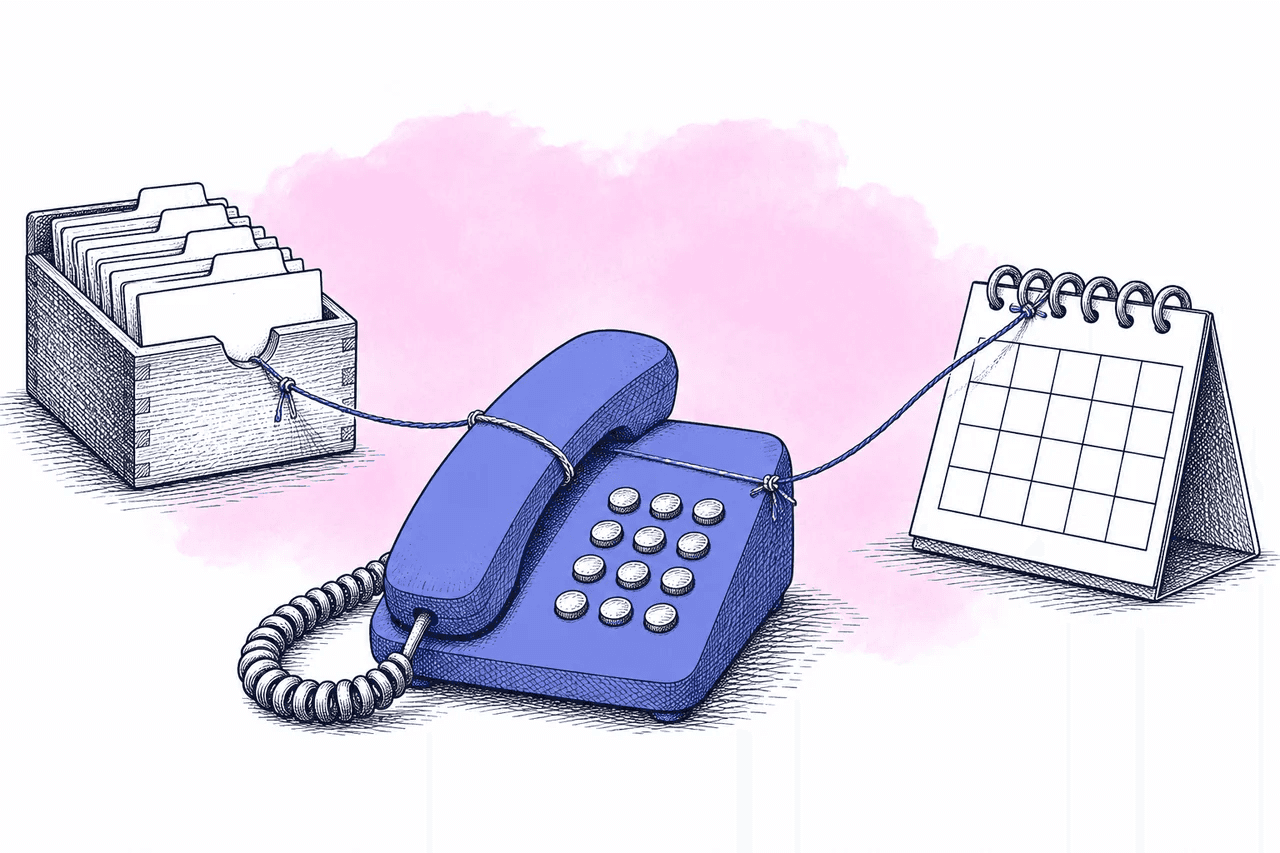
The free tiers of the large CRM makers are real but small. As published in November 2026, HubSpot's free CRM is "free for up to 2 users" with up to 1,000 contacts, and Zoho CRM is "free forever for 3 users."
The full answer
The brand matters less than one question none of the pricing pages answers: does each lead arrive with its source filled in automatically, or does someone have to type it?
How much does a CRM cost for a small business?
CRM software for a small business is priced per user per month. The entry plans, as published in November 2026, run about $20 to $25 a user a month at list price:
| CRM | Free plan | Entry paid plan |
|---|---|---|
| HubSpot | Up to 2 users | Starter, normally $20 per seat a month (new-customer discounts offered) |
| Zoho CRM | Up to 3 users | Standard, priced per user a month |
| Salesforce | None listed | Starter Suite, $25 per user a month |
The full answer
The subscription is the small part. Setup (forms, phone, booking system and email feeding it), moving old contacts in, and someone's time to keep it clean cost more than the license in the first year. A CRM nobody connects to the website is a contact list with a monthly fee.
Speed to lead: the 5-minute rule
Speed to lead, as audited InsideSales, 2016: web forms of 4,723 companies
Average time companies took to respond to a web lead.
Share of leads that got a response within five minutes.
Share that never received a personalized response of any kind.
The 5-minute rule says to reply to a new lead within five minutes, while the person is still holding their phone and before they call the next name on the list. It is a rule worth keeping because almost nobody does:
The detailslist of 3 · insidesales.com, workato.com
- In InsideSales' 2016 response audit, leads were sent through the web forms of 4,723 companies. "On average, companies took 38.35 hours to respond," "only 7.7% of leads received a response" within five minutes, and 50% "never received any personalized response of any kind."
- Workato tested 114 B2B companies in 2026: "More than 99% of companies aren't responding within 5 minutes," and "none of the companies called within 5 minutes."
- Harvard Business Review's study of online leads, "The Short Life of Online Sales Leads", opens with the same finding: "most companies are not responding nearly fast enough."
A business that answers in five minutes is already faster than most of the companies in those audits. A CRM makes that possible in two ways: an instant alert to whoever is on duty when a form or booking comes in, and one list where an unanswered lead is visible to everyone, instead of sitting in one person's inbox. Where the business books online, the booking itself can land in the CRM and the calendar: Waterfall's site bookings do exactly that.
Is a CRM difficult to learn?
No, not the part a small business uses. Adding a lead, moving it to the next stage and setting a follow-up takes an afternoon to learn. CRMs feel hard when they are set up with dozens of fields and stages nobody needs.
The full answer
Start with the columns from the spreadsheet above, and add fields only when someone asks for a report that needs them.
Downsides of a CRM, and why so many fail
CRMs fail for a few reasons, and almost never because of the software:
- Nobody enters the data. Calls are answered and never logged, so the CRM shows half the leads.
- Too much setup. Twenty required fields make logging a lead slower than not logging it.
- No source on the lead. Without it the CRM can say who called, not which marketing made them call.
- Cost creep. Per-seat pricing grows with every person added, and the useful features sit in higher plans.
- Lock-in. Moving years of records out of one system into another is work; check that you can export.
The details
The fix for most of them is the same: fill as much as possible automatically (forms, bookings, the source of each visit) and keep what people must type to a minimum.
AI and CRMs
Can AI build me a CRM system?
Yes, a simple one. An AI assistant can write a spreadsheet template with stages and formulas, or a small app, in an hour. What it cannot do is connect your phone, forms, booking system and website to it so leads arrive with their source, or make your team use it. Building the table is the easy part.
Will CRMs be replaced by AI?

Not the record of your customers. AI is changing how people work in a CRM: writing follow-ups, summarizing calls, suggesting the next step.
The full answer
Every one of those features needs the same thing underneath: a list of your leads and customers, with where they came from and what happened. A business without that list has nothing for the AI to work on.
What we set up instead of a CRM you have to run
Nizo Luxury: bookings by source CRM attribution, August 22, 2026 – November 8, 2026
With LA Ranks Marketing Agency, lead tracking and the CRM are not a separate purchase or a project you manage. They are set up for you and included in growth marketing, from $3,900 a month:
Every lead carries its source
without anyone typing it: Google search, Maps, ChatGPT and other assistants, social media or a referral, recorded on your site the moment the call tap, text, form or booking happens.
The forms and bookings feed it
, so the list is complete, and an alert goes to whoever answers.
The monthly report starts there
leads by source, then the pages and searches behind them.
You keep the data.
The leads are your business's records, not ours.
The details
For Nizo Luxury, that record showed 6 bookings from ChatGPT and 13 from Google organic search between August 22, 2026 and November 8, 2026, a split a typed-in source field would not have caught.
Questions
Do I need a CRM?
LA Ranks Marketing Agency's answer: you need a CRM once leads reach you through more than one door (calls, forms, texts, messages, bookings) and more than one person answers them. Below that, a shared spreadsheet works. A CRM that keeps each lead's source also shows which marketing pays: for Nizo Luxury, an LA car rental, the CRM attributed 6 bookings to ChatGPT and 13 to Google organic search between August 22, 2026 and November 8, 2026.
What is a CRM, for beginners?
CRM stands for customer relationship management: one shared list of every lead and customer, with how they found you, what they asked for, what you quoted and what happens next.
What is the 5 minute rule for leads?
Reply to a new lead within five minutes, while the person is still at their phone and before they call the next business on the list. Few businesses manage it, which is why it works.
Can I use Gmail or Excel as a CRM?
Yes, for a handful of leads a week: one sheet with a row per lead, or Gmail labels for each stage. Both break once several people answer leads or calls and messages arrive outside email.